
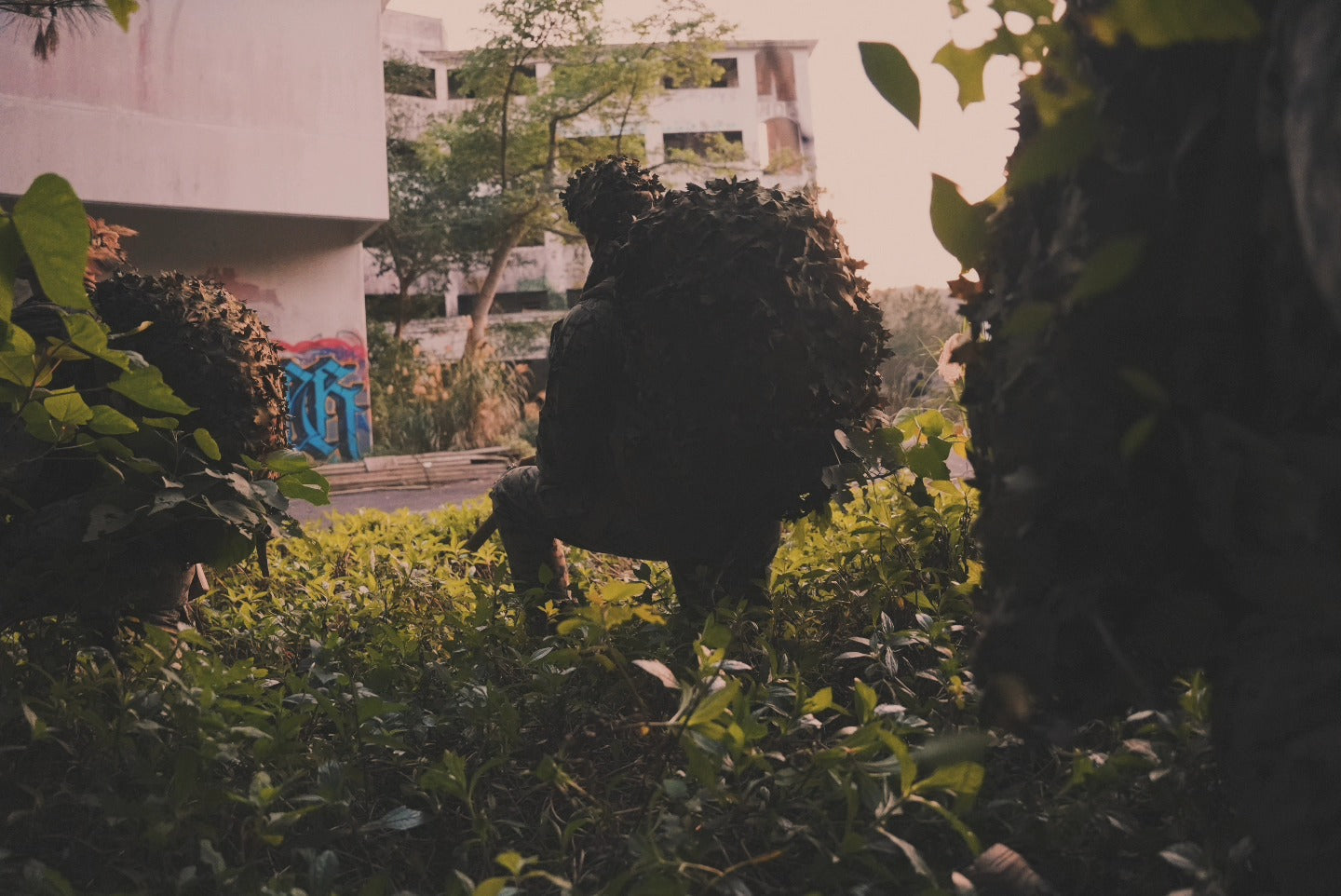
You’ve been waiting. Three hours already. Perfect position. Flawless concealment. The enemy walks by, fifty meters away, blind to your presence. You could fire now—or remain invisible. That moment, suspended between patience and power, is where camouflage becomes a psychological weapon. A weapon that strikes first. A weapon aimed at the mind.
On modern battlefields, camouflage has outgrown its decorative past. It’s now a cognitive force multiplier, a tool that attacks perception, warps orientation, delays decision-making. Whoever loops faster wins. Often, without firing a single round.
Three psychological levers govern this invisible dominance: the element of surprise (to paralyze observation), the erosion of morale (to mentally exhaust through invisibility), and cognitive overload (to saturate analysis and slow decisions). Whether you’re an infantry soldier, a squad leader, or a tactical airsoft player, these mechanisms are your edge—if you understand and apply them.
Fundamentals: Why Camouflage Targets the Mind Before the Sensors | Camouflage and Psychology
The OODA Loop — Striking at the Core of Decision
Every confrontation pits two cycles against each other: Observe – Orient – Decide – Act. The OODA loop compresses time, rewards agility, punishes hesitation. Camouflage enters right at the first step—observation. It clouds the eye, delays orientation, corrupts interpretation, derails the action.
A simple, ruthless chain:
-
Compromised observation → the threat isn’t seen, or seen too late.
-
Distorted orientation → the situation is misread.
-
Faulty decision → the wrong response follows.
-
Ineffective action → executed late, misplaced, or useless.
You cycle fast. Your adversary crawls. You dictate the tempo; he reacts to it.
From Visible to Multispectral — The Signature War
You’re not just seen—you’re detected. Visible light, near-infrared, thermal, radar, acoustic, electromagnetic: each spectrum adds a layer of vulnerability. The answer is signature management—flatten brightness, smooth temperature, break the outline, silence emissions. Across the spectrum, across every phase of movement, you control what the enemy perceives.
First Lever: The Element of Surprise — Disorganize and Outpace | Camouflage and Psychology
The Absence Bias: “I Don’t See Anything, So Nothing’s There”
The brain cuts corners. It trusts absence. “No sign—no threat.” That shortcut is your weapon. You feed the illusion, stretch the moment. The enemy grows careless, reallocates focus, lowers his guard. He opens gaps without realizing it.
Thermal decoys, radar profiles disguised as rocks or trucks, neutral visual shapes—they all exploit this bias. The eye relaxes. The system misclassifies. You gain seconds. Sometimes minutes. Always the initiative.
Winning the Decisive Seconds
In combat, a half-second can decide who lives. A camouflaged unit that fires before being seen seizes:
-
Complete initiative in the first exchange,
-
Ten to fifteen meters of positional advantage,
-
A multiplied lethality through shock and confusion.
Camouflage gives time—and time kills. By manipulating temperature signatures, reflections, and geometry, you force sensors to misjudge, and operators to hesitate. That moment of doubt is all you need.
Collapsing the Enemy’s Mental Map
Every soldier builds a mental model of terrain: cover, angles, expected silhouettes. Break it. Use 3D nets, fractal textures, shadow control, and flat thermal surfaces. Once those reference points vanish:
-
Distances blur.
-
Shapes confuse.
-
Fire alignment fails.
The map turns unreliable. The mind follows.
Second Lever: The Erosion of Morale — The Invisible That Drains | Camouflage and Psychology
Stress, Hypervigilance, Tactical Paranoia
Taking fire from nowhere crushes the psyche. Constant uncertainty breeds hypervigilance, which leads to fatigue and errors. Soldiers jump at shadows, waste ammo, distrust their sensors. Cohesion cracks. Movement slows. They become defensive, predictable, hesitant.
Invisible pressure does more than bullets—it corrodes confidence.
When Defenses Fail, Doubt Spreads
Despite drones, radars, or thermal optics, the attacks still come—from nowhere. The result: disbelief.
-
“Our sensors don’t work.”
-
“Our assumptions are wrong.”
-
“Our commanders misjudge.”
Doubt spreads faster than fire. Units lose initiative. Commanders delay. Fear replaces aggression. You, unseen, hold the mental high ground.
The Ambush That Haunts
A perfectly hidden ambush leaves scars. “They were right there—and no one saw them.” That sentence becomes legend. It circulates through ranks, eroding courage, amplifying fear. Soldiers hesitate to move forward; leaders second-guess every order. The invisible becomes omnipresent.
Third Lever: Cognitive Overload — Saturate the Enemy’s Mind | Camouflage and Psychology
Endless Vigilance: The Invisible Tax
Searching for what can’t be seen is exhausting. Continuous patrols, data cross-checks, and sensor feeds drain focus. The OODA loop slows down; errors multiply. Misclassified signals, wasted focus, late responses—mental fatigue wins the battle before weapons do.
Sensor and Analyst Saturation
Artificial intelligence helps, but at a cost: data volume, power demand, human supervision. Each decoy you plant, each false signature you emit, multiplies their workload. Their ISR chain (Intelligence–Surveillance–Reconnaissance) stretches thin. The longer they chase ghosts, the stronger your invisibility becomes.
High-Impact Camouflage Techniques | Camouflage and Psychology
Signature Discipline for the Individual Fighter
Visual. Non-repetitive disruptive patterns. Broken outlines. No shine. Shadow awareness.
Thermal. Low-emissivity fabrics, spaced layers to diffuse body heat, avoidance of metal bridges or exposed plates.
Acoustic. No clinking gear. Irregular pacing. Fabric wraps on noisy surfaces.
Electronic. Strict EM discipline—low power, short bursts, randomized timing.
Light. Filtered screens, masked lamps, no reflections.
Simple law: what catches the sensor catches the eye—eliminate it.
Multispectral Systems for Vehicles and Bases
Nets and Covers. 3D textures disrupt form; absorbent pigments soften radar; thermal management cools surfaces.
Adaptive IR Camouflage. Thermal panels that mimic backgrounds, or project harmless “civilian” heat signatures.
Reflection Control. Every glint betrays you—lamps, mirrors, visors, even puddles.
Decoys and Deception
Thermal decoys. Shift hotspots, draw sensors off your real position.
Radar decoys. Inflate a small target or disguise a large one.
Narrative deception. Plausible civilian patterns, supply convoys, or dummy signals—feed the enemy’s assumptions.
Tactical Employment: Where Camouflage Hits Hardest | Camouflage and Psychology
Synchronize Concealment with Tempo
Camouflage is tempo control. You decide when to strike, where to appear, when to vanish. Use smoke, decoys, and signal jamming together. Hit right after confusion peaks—when the enemy’s OODA loop is still resetting.
Negative Silhouettes and Blind Angles
Operate in the unseen zones: cold gaps in thermal fields, backlight silhouettes, textured backgrounds that devour outlines. Eyes seek contrast; sensors seek pattern. Offer neither.
Micro-Mobility and Patience
Move slowly, irregularly, always under micro-cover. Depressions, edges, urban debris—each meter chosen, not rushed. Stop before sensor beams. Wait. Move when they look away. One well-timed step equals ten careless ones.
Case Studies (Open Sources)
Armored Vehicle with Active Thermal Skin
A mechanized company equips vehicles with thermal-regulated panels. Signature drops. Identification lags. Observers misread: rock or truck? The column crosses a watched sector without contact. Surprise intact.
Logistics Convoy Under Multispectral Netting
A forward supply point wrapped in 3D multispectral nets. Visual and IR contrast collapse. Drones flag “low activity.” Strike reprioritized elsewhere. Enemy analysts grow frustrated: “We scan, we see nothing, yet we’re hit elsewhere.” Invisible pressure, visible fatigue.
Anticipating Enemy Countermeasures
Sensors, AI, and Multi-Source Fusion
Your opponent will combine visible, IR, radar, and acoustic feeds, using neural networks trained on camouflaged targets. But the system bleeds resources—data, power, human oversight. You fight back with variation: shifting patterns, false signatures, unpredictable landscapes. Each false positive burns their time. Each misread image wins you space.
Survivability Doctrine: Masking, Mobility, EM Silence
Masking. Conceal whenever static.
Mobility. Move outside satellite windows, through dead zones, unpredictably.
EM Silence. Short bursts, low power, never link movement with transmission. Ever.
Field Checklist: Turning Theory into Reflex
Individual / Tactical Airsoft
-
Matte everything—paint, tape, gear.
-
Break outlines—3D nets, local vegetation.
-
Manage heat—vent torso, avoid hot plates.
-
Stay silent—tighten gear, eliminate rattles.
-
Control light—filter screens, mask flashlights.
-
Move irregularly—pause, shift, hide in shadow.
Squad or Section Leader
-
Map likely sensor routes and drone windows.
-
Always carry decoys—thermal pads, reflectors.
-
Use 3D nets and heat masks for posts.
-
Drill “detect → break signal → relocate” until automatic.
Vehicle Crews
-
Deploy multispectral covers both moving and parked.
-
Cool down before entering watched zones.
-
Antiglare treatments on glass and lamps.
-
Radio silence during final approach.
-
Ready smoke and decoy launchers for break contact.
Operational Logic: Where Camouflage Strikes the Mind
Preparation and Approach
Hide sensors and antennas. Conceal direction and timing. Create attention debt through false alarms, then hit out of sequence.
Mobile Defense
Elastic positions. Shift before detection. Force engagement where you no longer are. Sustain mental attrition—night alerts, false signatures, irregular routines.
Joint and Cyber-Electronic Operations
Combine physical camouflage with electronic deception. False echoes, spoofed radio trails, plausible narratives. Confuse intelligence networks; overwhelm command bandwidth. The mental battle starts before the first engagement.
Frequently Asked Questions (FAQ)
Why is camouflage so effective against the enemy?
Because it attacks observation, the first step of the OODA loop. Without reliable observation, the rest collapses—orientation, decision, action. You own the tempo.
What types of camouflage are used today?
From traditional nets and patterns to multispectral systems (visible, NIR, IR, radar) and active thermal camouflage, combined with decoys and strict electromagnetic discipline.
How does camouflage affect enemy operations?
It delays reactions, multiplies errors, disperses resources, and drains mental stamina. Confusion equals advantage.
Is camouflage only visual?
No. It’s multispectral—visible, infrared, radar, acoustic, electronic. It’s called signature management now.
How do you counter an enemy skilled in concealment?
Use sensor fusion, AI detection, and disciplined analysis. But remember: these countermeasures are costly and slow. Exploit that with decoys, noise, and constant variation.
Conclusion
Camouflage isn’t decoration—it’s cognitive warfare. It breaks perception, delays decisions, weakens morale. It creates seconds, forces mistakes, and shapes tempo.
Your craft: reduce signatures, vary cues, deceive constantly, break the link between movement and signal, synchronize invisibility with action.
Master your signature. Command the loop. Become invisible.
Best regards,
The Nutsof Team
Advanced Camouflage & Defense Solutions
🌐 www.nutsof.com
Follow us on Facebook and Instagram for the latest in advanced military camouflage technologies.